PHENOMENA STUDIES WEAVER AXIOM
Studies Archive About
← INDEX

STUDY #07  ·  2026 · IN OBSERVATION

Kuramoto Model

A model-driven visual study of spontaneous synchronization.

MOVING IMAGE — PHASE DISC K breathing across Kc · r 0 → 0.85

WHAT IS THIS

Synchronization is what a crowd of oscillators does when each one, ticking at its own natural rate, nudges the others just a little. Fireflies flashing in unison, pacemaker cells, an audience clapping into rhythm — all the same story. Below a critical coupling the phases stay scattered; above it the population locks into a common beat. Nothing tells them to; the order emerges on its own.

The Kuramoto model strips this to its minimum: each oscillator is just a phase on a circle, pulled toward the average of all the others. This study runs a mean-field population of these oscillators in real time on the GPU, sweeping the coupling across the synchronization transition.
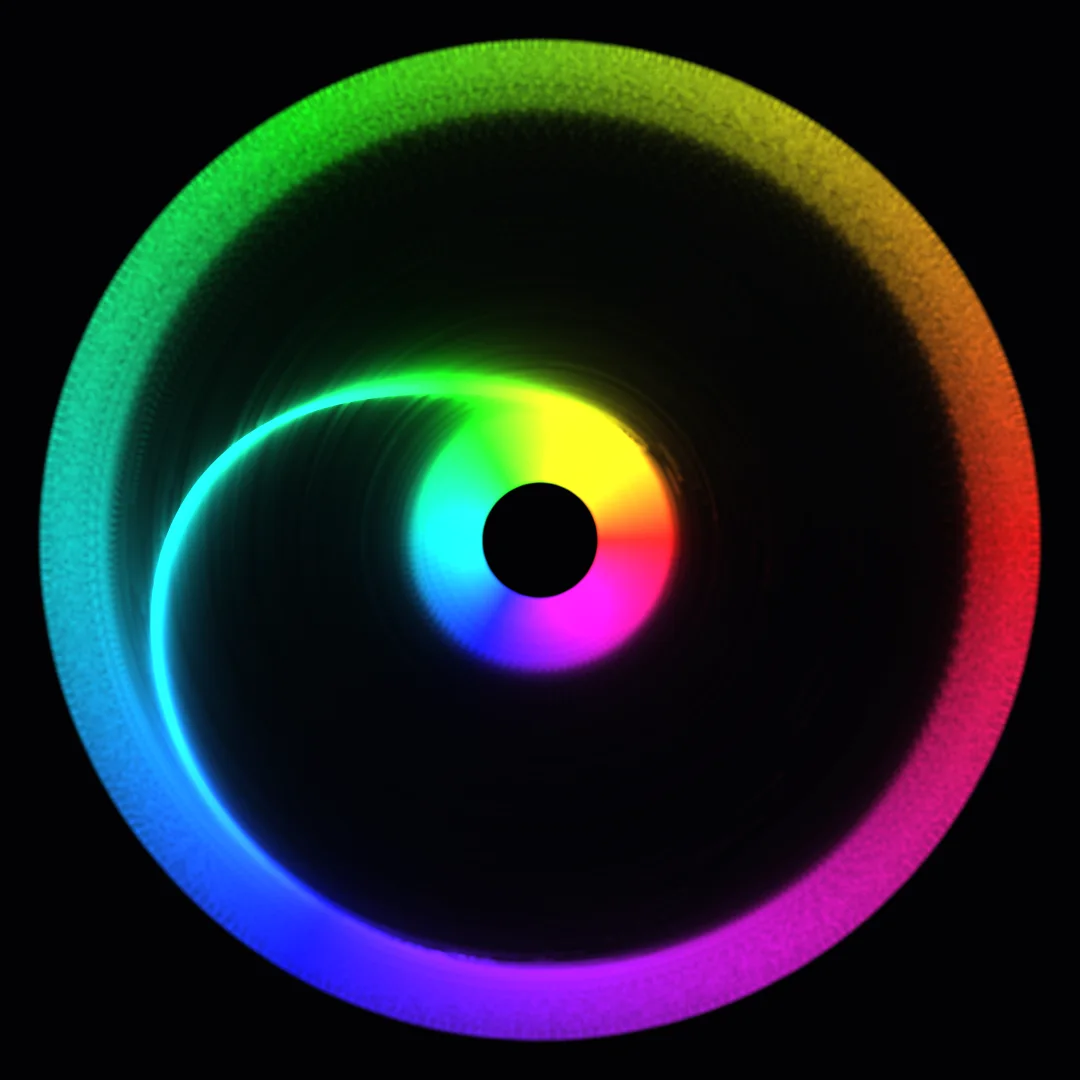
the coherent arm — a locked cluster out of the drifting halo
the coherent arm — a locked cluster out of the drifting halo K 3.0 · lorentzian · phase · r 0.58
Motif coupled phase oscillators / order parameter / phase transition
Method A small simulator was generated and modified with AI assistance, then ported to a real-time GPU (GLSL) renderer — a mean-field population of coupled phase oscillators, shown as a phase circle and as a rotor field of trails. The visual output was selected through curated parameter exploration.
Observation Above a critical coupling the population condenses into a single rotating arm — synchrony reading as a spinning rainbow collapsing to one hue — while the extreme-frequency oscillators never join and drift as a halo at the rim.
Reference Yoshiki Kuramoto, "Self-entrainment of a population of coupled non-linear oscillators," International Symposium on Mathematical Problems in Theoretical Physics, Lecture Notes in Physics, vol.39, 420-422 (1975).
Tools Python / NumPy / three.js / React / GLSL / ffmpeg / AI coding assistant
Year 2026

This is not a scientific simulation result, but a visual interpretation of the phenomenon.

A NEW CHAPTER

From a field in space to a population in phase.

Studies #01–06 — space Study #07 — population
What is drawn a field over the plane — concentration, height, intensity a population of oscillators, sorted onto a disc by frequency
Colour a concentration, a temperature, a path difference phase itself — the angle each oscillator has reached
The order patterns fixed by the geometry of diffusion synchrony — emerging in time, past a critical coupling

PARAMETERS EXPLORED

param meaning effect on the image
K the coupling strength between oscillators the transition itself: below Kc = 2γ a sheared rainbow (incoherent), above it a coherent arm (synchronised)
γ / width the spread of natural frequencies sets the critical coupling Kc = 2 / (π g(0)) — a wider spread is harder to synchronise
g(ω) the shape of the frequency distribution lorentzian is the classic closed-form case; gaussian locks tighter; bimodal splits the crowd into two groups
colour phase → hue, or ω → temperature phase condenses to one hue at synchrony; ω shows the split between the locked band and the drifting rim
decay / exposure the trail exposure the length and depth of the rotor trails — how engraved the rings read

Each image below records its exact parameter set.

THE MATHEMATICS the model behind the images

Each oscillator is a single phase on a circle, pulled toward the average of all the others. The whole crowd collapses to one mean field.

dθidt=ωi+KN∑jsin⁡(θj−θi)\frac{d\theta_i}{dt} = \omega_i + \frac{K}{N}\sum_{j} \sin(\theta_j - \theta_i)dtdθi​​=ωi​+NK​j∑​sin(θj​−θi​)
N oscillators, each with its own natural frequency ω_i, coupled all-to-all at strength K.
r e iψ=1N∑je iθjr\,e^{\,i\psi} = \frac{1}{N}\sum_{j} e^{\,i\theta_j}reiψ=N1​j∑​eiθj​
The complex order parameter — the centroid of the crowd on the circle. r ∈ [0,1] is the degree of synchrony; ψ the mean phase.
dθidt=ωi+K r sin⁡(ψ−θi)\frac{d\theta_i}{dt} = \omega_i + K\,r\,\sin(\psi - \theta_i)dtdθi​​=ωi​+Krsin(ψ−θi​)
The mean-field form: every oscillator now follows only the average (r, ψ) — the O(N) reduction the GPU runs.
Kc=2π g(0) ,r=1−KcK  (K>Kc)K_c = \frac{2}{\pi\,g(0)}\,,\qquad r = \sqrt{1 - \frac{K_c}{K}}\ \ (K > K_c)Kc​=πg(0)2​,r=1−KKc​​​  (K>Kc​)
The critical coupling from the frequency distribution g(ω); for a Lorentzian spread the synchrony grows along this closed-form branch.

Inspired by the Kuramoto model of coupled phase oscillators — a visual interpretation, not an exact reproduction.

SELECTED STILLS — 5
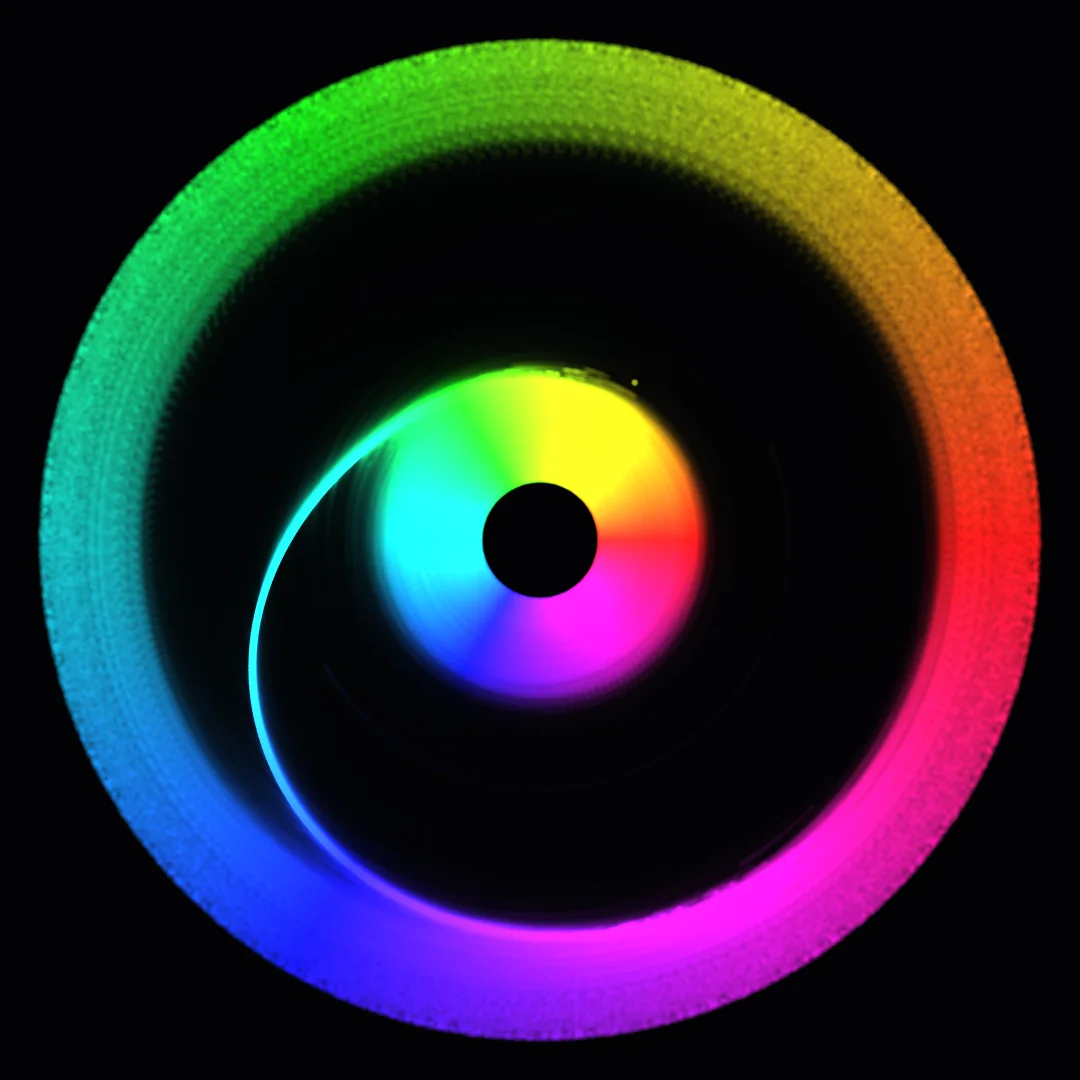
the coherent arm — above Kc
the coherent arm — above Kc K 3.0 · lorentzian · phase · aurora · r 0.58
onset — the arm just emerging
onset — the arm just emerging K 2.5 · near-critical · phase · r 0.44
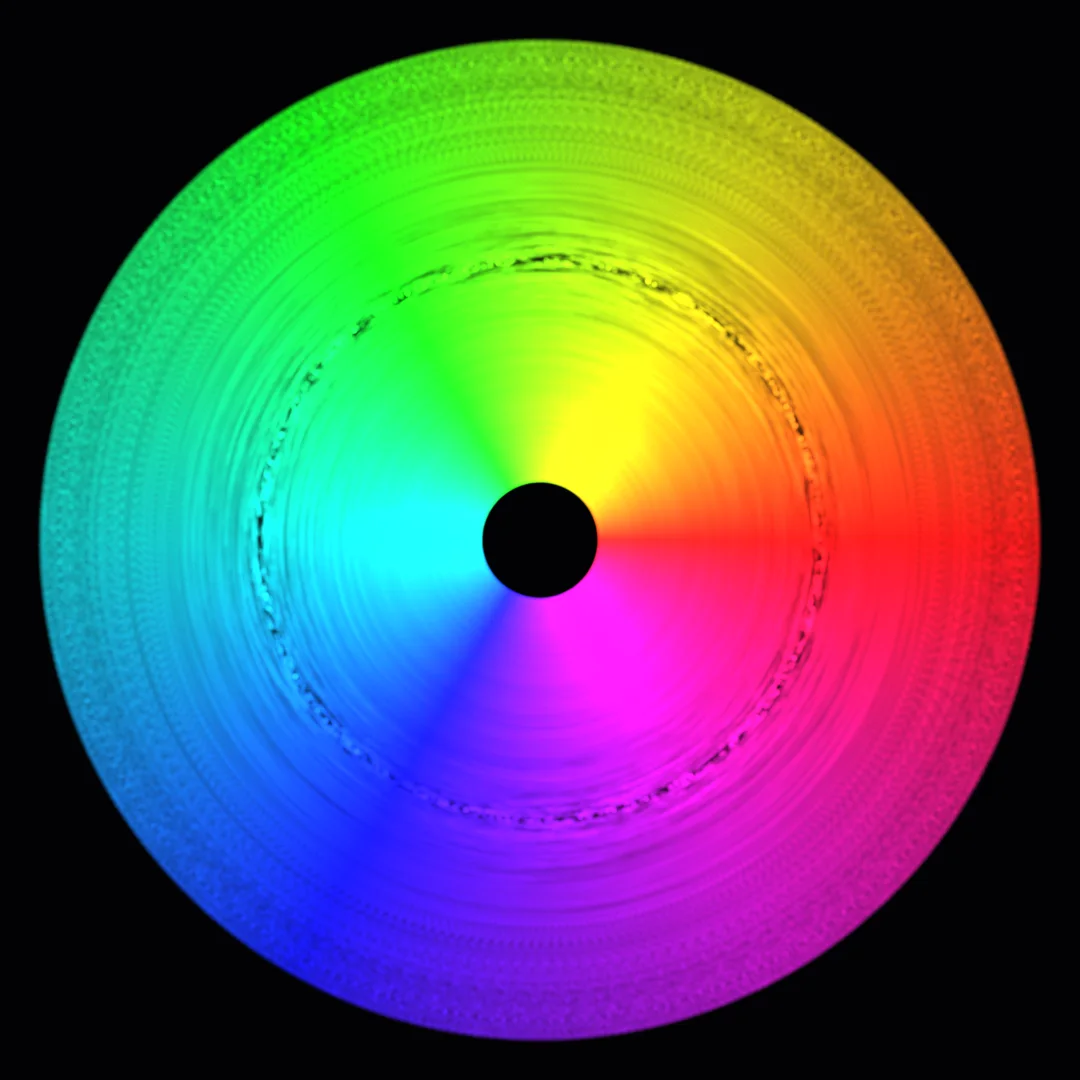
differential shear — below Kc
differential shear — below Kc K 1.0 · incoherent · phase · r 0.005
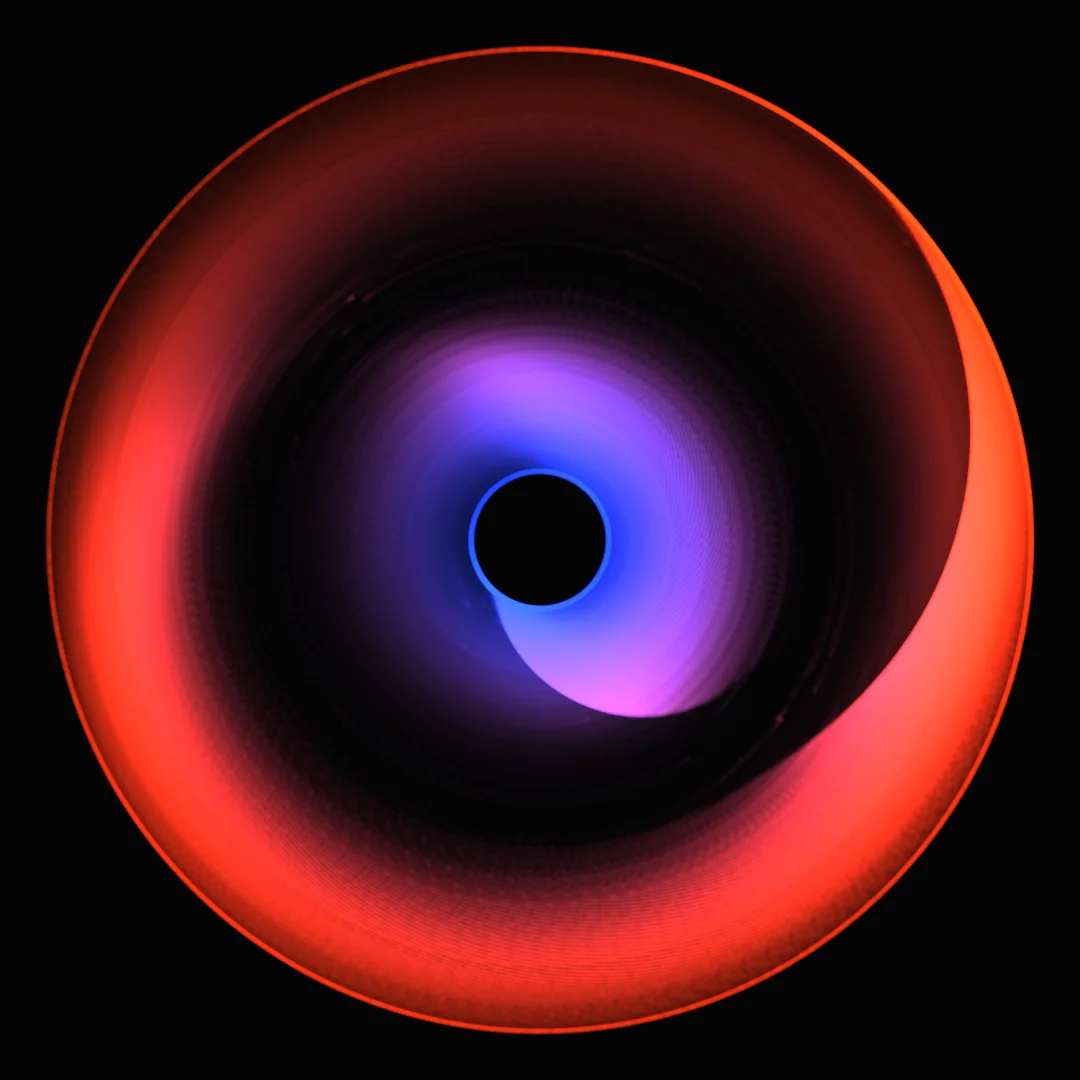
two groups — a bimodal distribution
two groups — a bimodal distribution K 3.0 · bimodal · ω-colour · ember
firefly — the real-world anchor
firefly — the real-world anchor K 3.0 · width 0.8 · ω-colour · firefly

PROCESS — PARAMETER SWEEPS

The whole transition in one frame: as the coupling K climbs past the critical value, the sheared rainbow disc condenses into a single coherent arm and the order parameter r rises from nothing toward one.
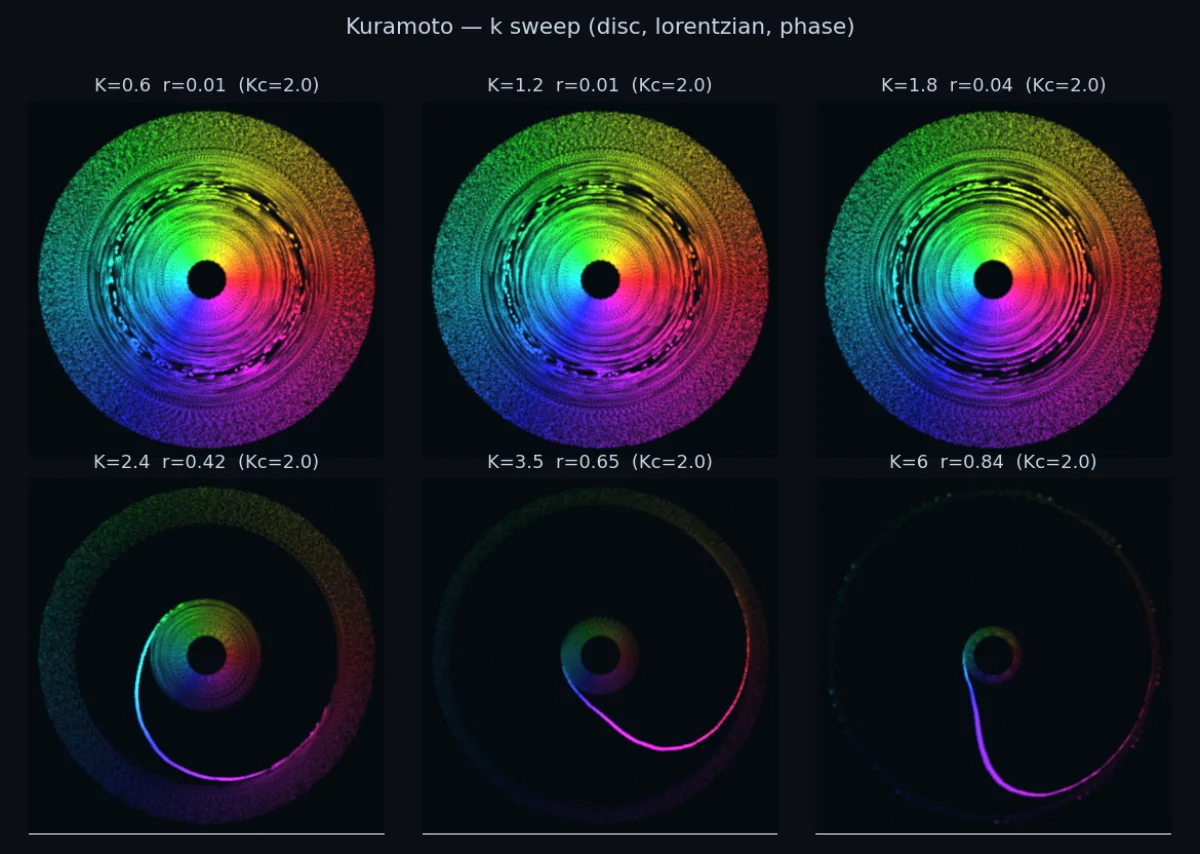
A coupling sweep across the transition
A coupling sweep across the transition K 0.6→6 · lorentzian · Kc 2.0 · r 0.01→0.84

COLOUR = PHASE

Here colour is not a material property but the phase itself. A phase is an angle that wraps around, and the colour wheel is the canonical way to draw a cyclic quantity — so mapping phase to hue is an honest encoding, not decoration. Synchrony then reads directly: a spinning rainbow condensing into one hue.

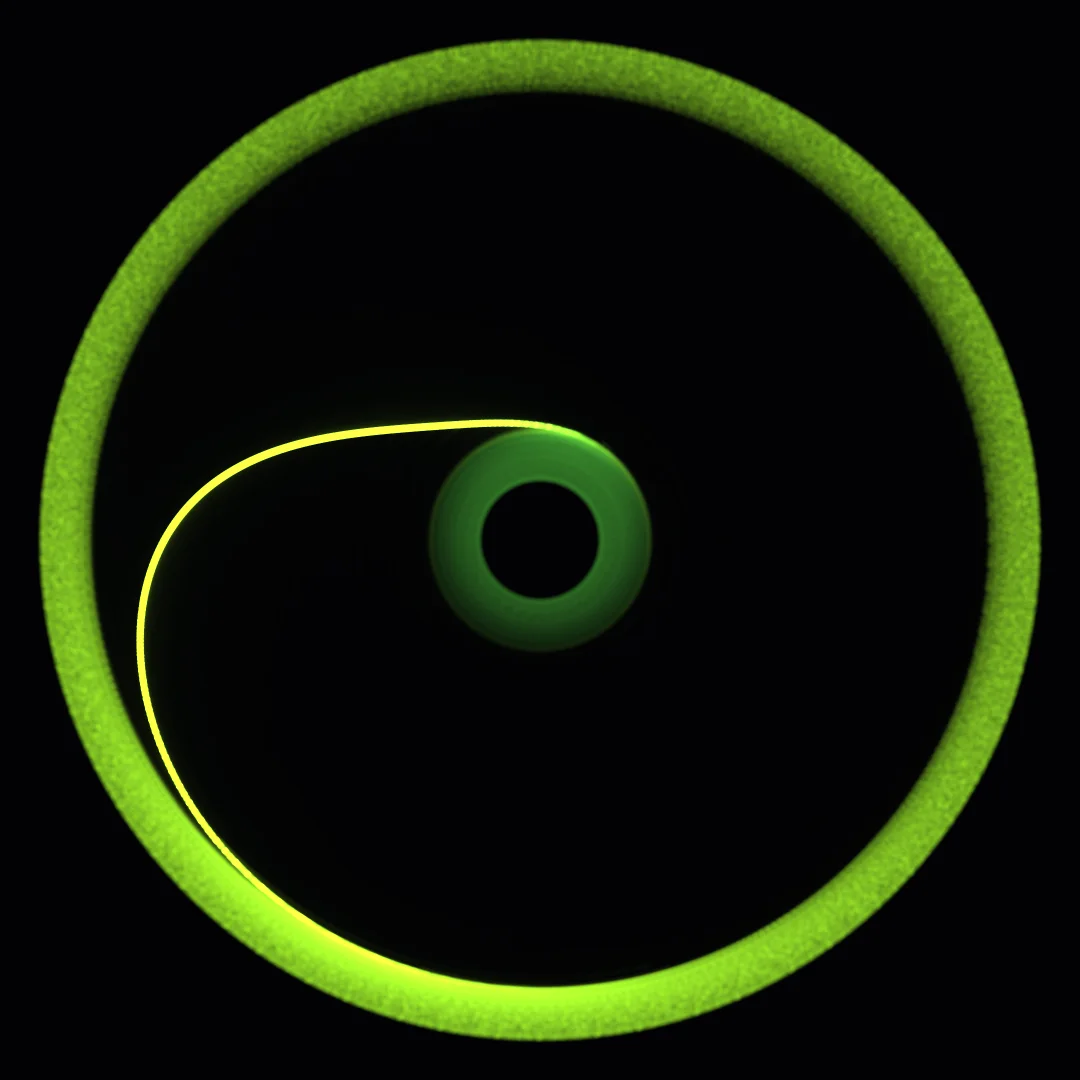
The radius orders oscillators by their natural frequency, so the coherent core and the drifting rim are the phase-locked and drifting populations of the model. The firefly palette nods to the most literal real-world case — synchronous fireflies, whose "phase" is simply when each one flashes.

These are artistic mappings of dynamical quantities (phase, frequency), not measurements — unlike #01, where colour was a real catalyst oxidation state.

firefly — natural frequency as temperature, the synchronous flash as the bright arc
firefly — natural frequency as temperature, the synchronous flash as the bright arc K 3.0 · width 0.8 · ω-colour · firefly

Palette aurora / ember / firefly — hue = phase (or temperature = natural frequency) · radius sorts oscillators by frequency.

REFERENCES

  1. Yoshiki Kuramoto. "Self-entrainment of a population of coupled non-linear oscillators." International Symposium on Mathematical Problems in Theoretical Physics, Lecture Notes in Physics, vol.39, 420-422 (1975).
  2. Steven H. Strogatz. "From Kuramoto to Crawford: exploring the onset of synchronization in populations of coupled oscillators." Physica D, vol.143, 1-20 (2000).

INTERACTIVE STUDY

The whole subject of this study is a threshold. A population of phase oscillators runs live here, each ticking at its own natural rate and feeling only the crowd’s average. Drag Coupling across theKc tick and the spinning rainbow condenses into a single rotating arm — the order parameter r climbing as the group locks, falling back when disorder wins. It is a deliberately simplified instrument, capped in resolution with a few curated knobs and no export, separate from the full engine used to author the finished works.

SIMPLIFIED INSTRUMENTKURAMOTO · MEAN-FIELD · K LIVE

This interactive study is not intended as a scientifically validated reproduction. It is a visual interpretation generated from an implemented model and curated parameter exploration — and it is a deliberately simplified instrument, separate from the full engine used to author the finished works.

← ALL STUDIES STUDY #08 · PHASE SEPARATION · IN OBSERVATION →
PHENOMENA STUDIES — WEAVER AXIOM PERSONAL VISUAL RESEARCH · © 2026