STUDY #01 · 2026 · OBSERVED
Belousov–Zhabotinsky Reaction
A model-driven visual study of oscillating chemical patterns.
WHAT IS THIS
The Belousov–Zhabotinsky reaction is a chemical reaction that refuses to reach equilibrium. Instead of settling, its oxidation state oscillates in time; spread across a shallow dish, those oscillations couple with diffusion and travel outward as concentric target waves and rotating spirals. It is a textbook example of an excitable medium.
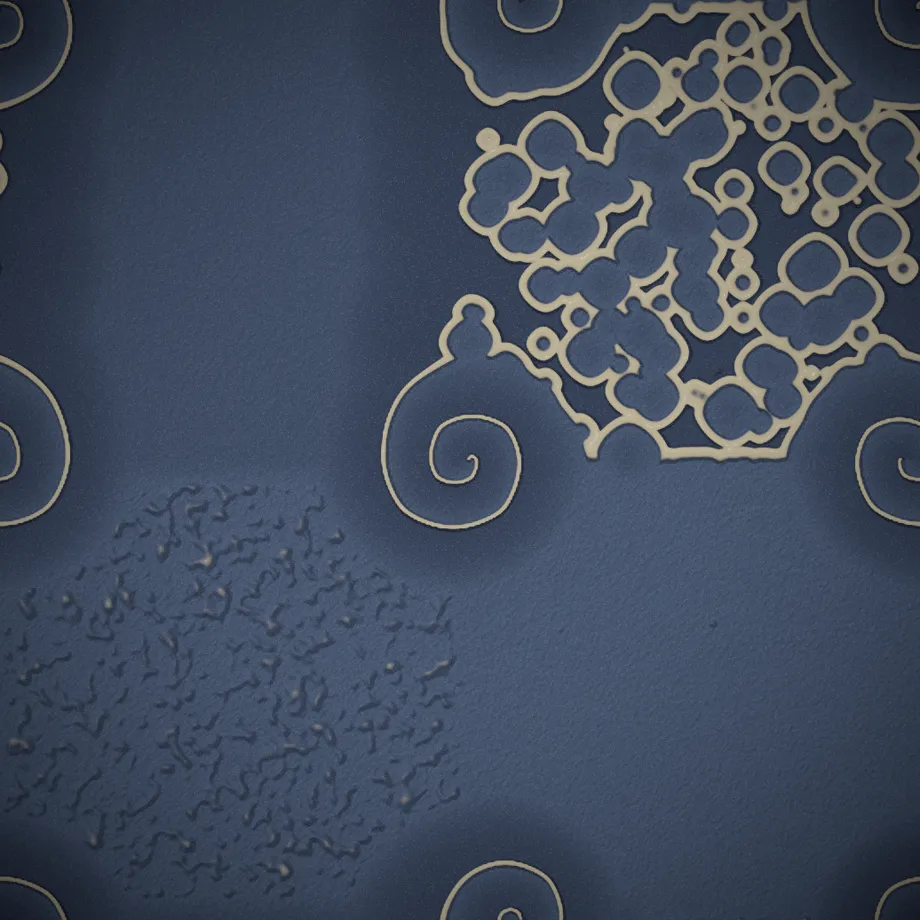
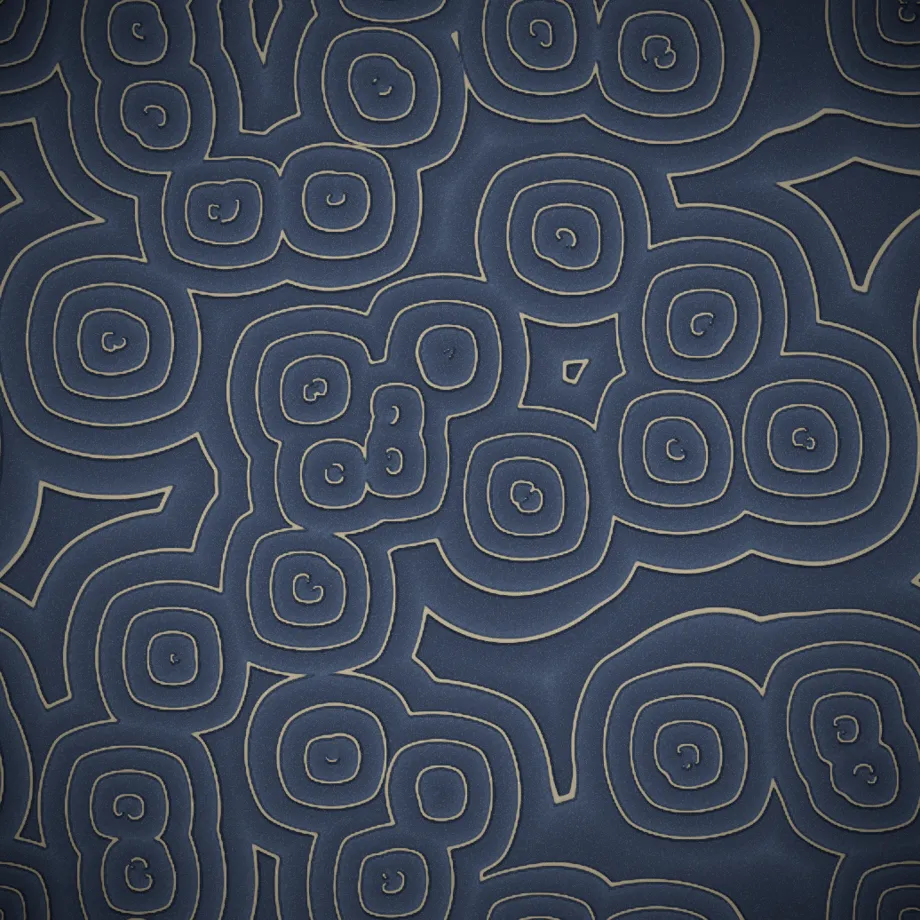
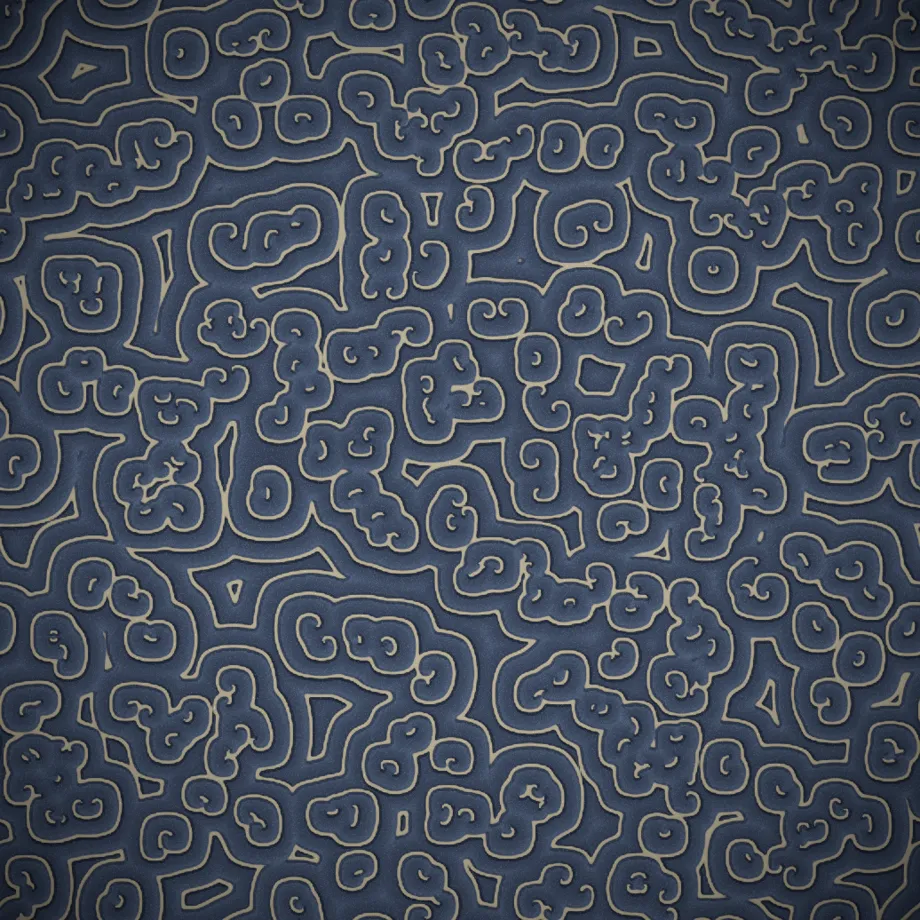
This study runs a two-variable Oregonator model — a reduced form of the reaction — as a reaction-diffusion field in real time on the GPU. Nothing is scripted: the waves emerge from the equations, and the parameters were swept by hand to find the regimes that read as images.
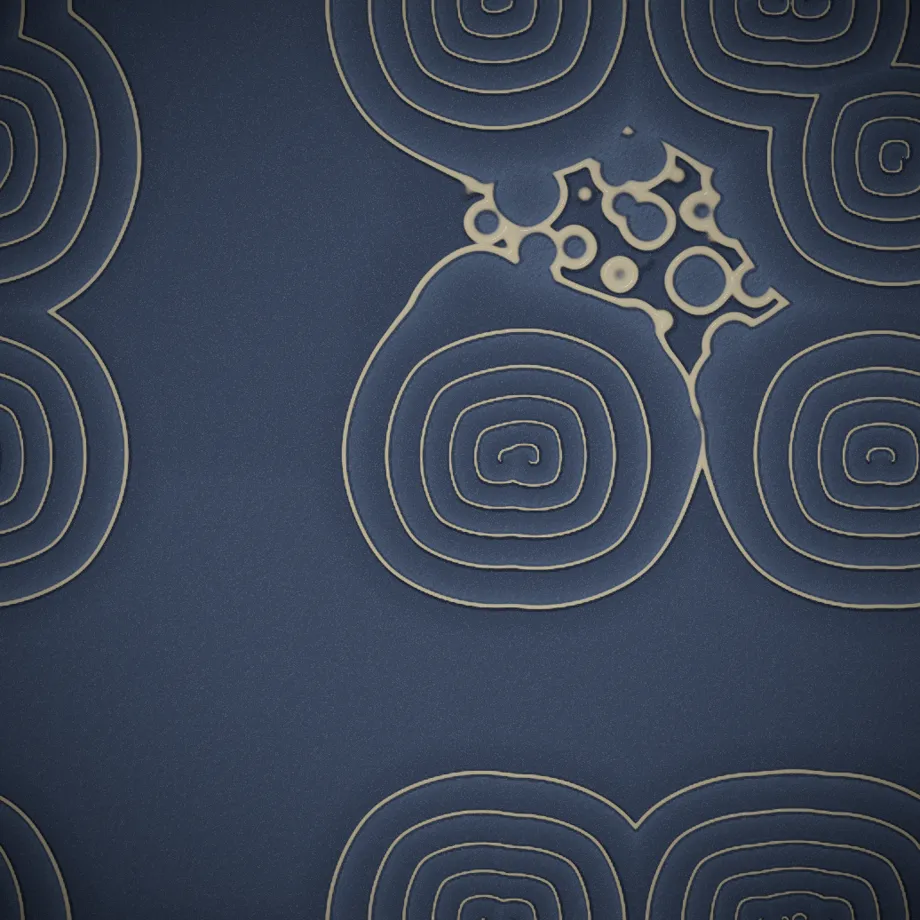
This is not a scientific simulation result, but a visual interpretation of the phenomenon.
PARAMETERS EXPLORED
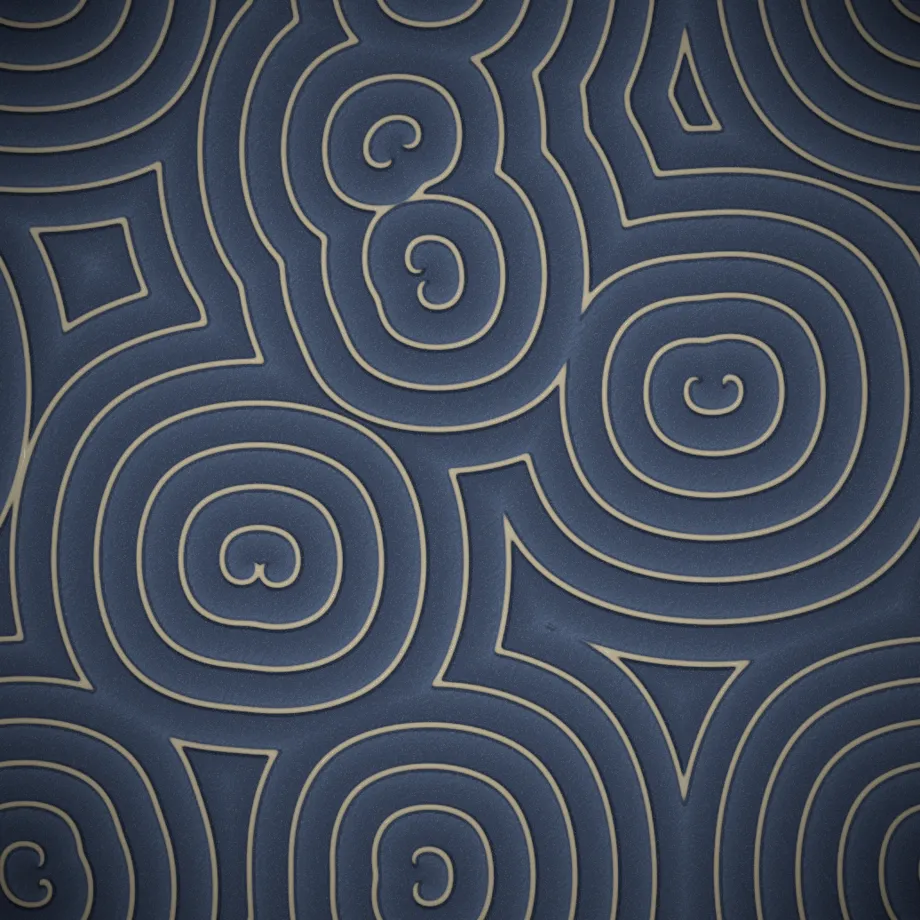
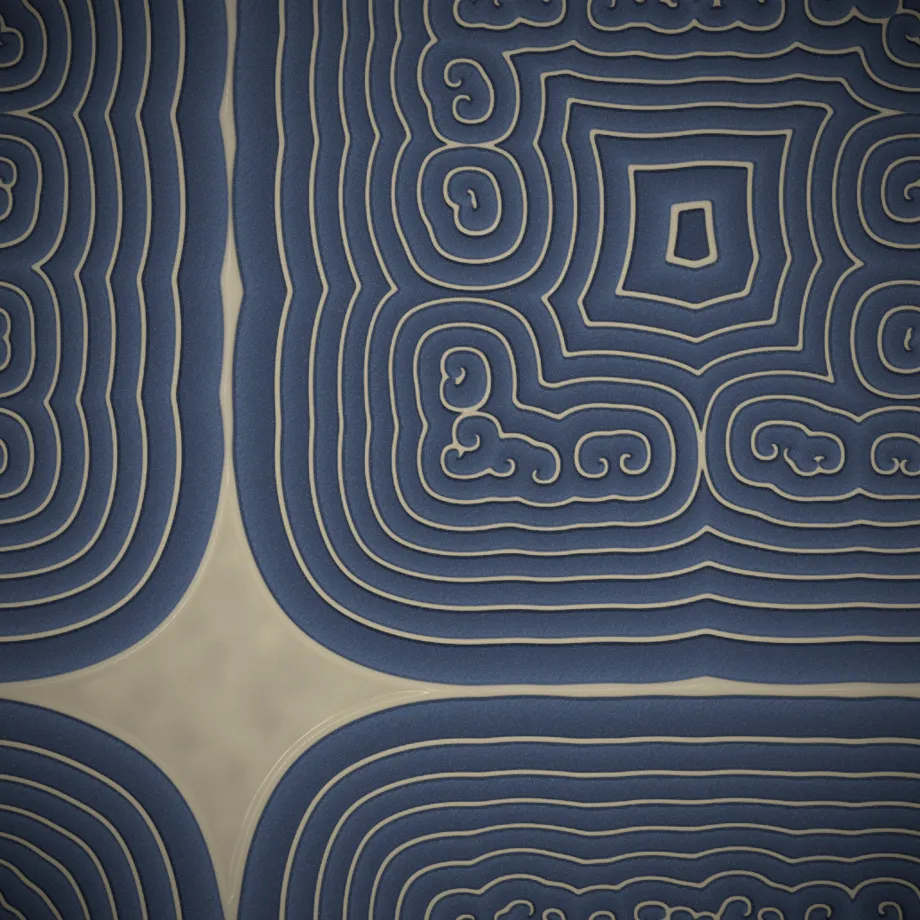
Each image below records its exact parameter set.
THE MATHEMATICS the model behind the images
The images run on the two-variable Oregonator (Tyson–Fife reduction) as a reaction–diffusion system — a fast activator u and a slow inhibitor v.
Inspired by the Oregonator model — a visual interpretation, not an exact chemical reproduction.
SELECTED STILLS — 6
PROCESS — PARAMETER SWEEPS
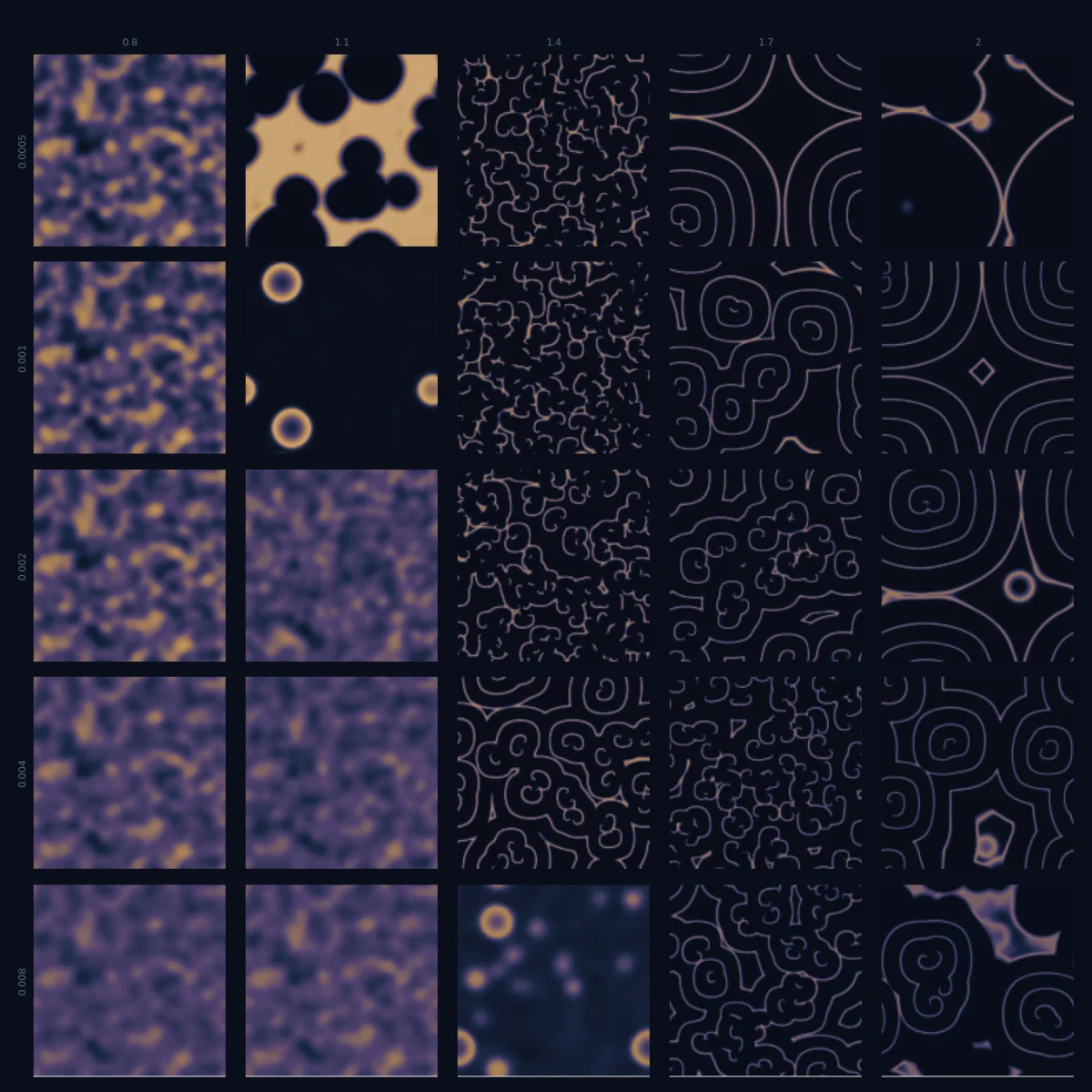
Every finished still above is one frame, chosen by eye, from a sweep like this — the model’s two main knobs, f and q, walked across their range.
COLOUR = REAL PHYSICS
In a real BZ dish, the colour you see is the metal catalyst switching oxidation state. In the model, the slow variable v is the fraction of oxidised catalyst — so colour is mapped to v, not to the wave's leading edge.
The four plates opposite are the same wave field — identical seed, identical step — rendered through four real catalysts. Ferroin's red ⇄ blue is the most vivid, which is why it became the icon of the reaction; cerium is barely there, and that low contrast is exactly why chemists reach for ferroin.
The site palette — weaver, deep navy ⇄ ivory — is a house colourway rather than a literal catalyst. All colours are artistic approximations of the reported indicator colours, not spectroscopic measurements.
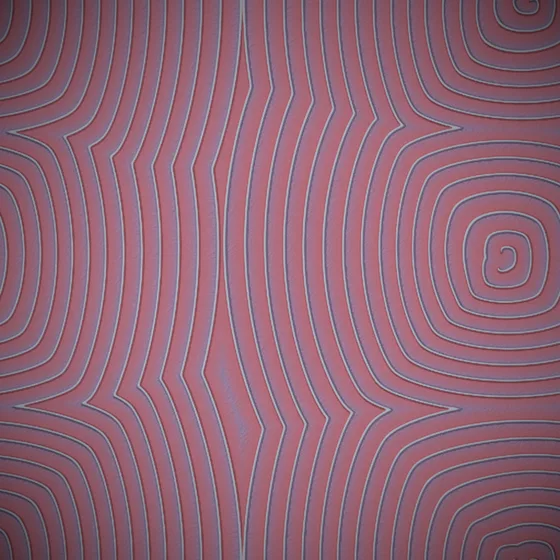



Same pattern, palette only — f 1.8 · q 0.001 · ε 0.035 · seed 5.
REFERENCES
- A. N. Zaikin, A. M. Zhabotinsky. "Concentration Wave Propagation in Two-dimensional Liquid-phase Self-oscillating System." Nature, vol.225, 535-537 (1970).
- R. J. Field, E. Körös, R. M. Noyes. "Oscillations in Chemical Systems. II. Thorough Analysis of Temporal Oscillation in the Bromate-Cerium-Malonic Acid System." Journal of the American Chemical Society, vol.94, 8649-8664 (1972).
- R. J. Field, R. M. Noyes. "Oscillations in chemical systems. IV. Limit cycle behavior in a model of a real chemical reaction." The Journal of Chemical Physics, vol.60, 1877-1884 (1974).
- J. J. Tyson, P. C. Fife. "Target patterns in a realistic model of the Belousov-Zhabotinskii reaction." The Journal of Chemical Physics, vol.73, 2224-2237 (1980).
INTERACTIVE STUDY
A small window into the model behind this study — a deliberately simplified instrument, reduced in resolution, scope, and rendering. The finished works above are something else entirely: parameters swept, frames chosen, and graded by hand from the full engine. This exists so you can feel how the field responds.
This interactive study is not intended as a scientifically validated reproduction. It is a visual interpretation generated from an implemented model and curated parameter exploration — and it is a deliberately simplified instrument, separate from the full engine used to author the finished works.